

The idea
“Discovery consists of seeing what everybody has seen and thinking what nobody has thought.” Albert Szent-Györgyi
Albert Szent-Györgyi (1893–1986) was a Hungarian biochemist who won the Nobel Prize in 1937 for isolating vitamin C. His most famous remark, that “discovery consists of seeing what everybody has seen and thinking what nobody has thought”, describes his own achievement perfectly: he found something new in a substance that had been in plain sight all along.
This week, we will implement the paper “Slope, Strength, and Retail Extrapolation” by Chad Schmerling (2026). Imagine two stocks with the same 12-month return. One is a screaming buy, the other a short. Standard momentum can’t tell them apart: it sees only the endpoint. But this new paper shows that the alpha hides in the shape of the path between them.
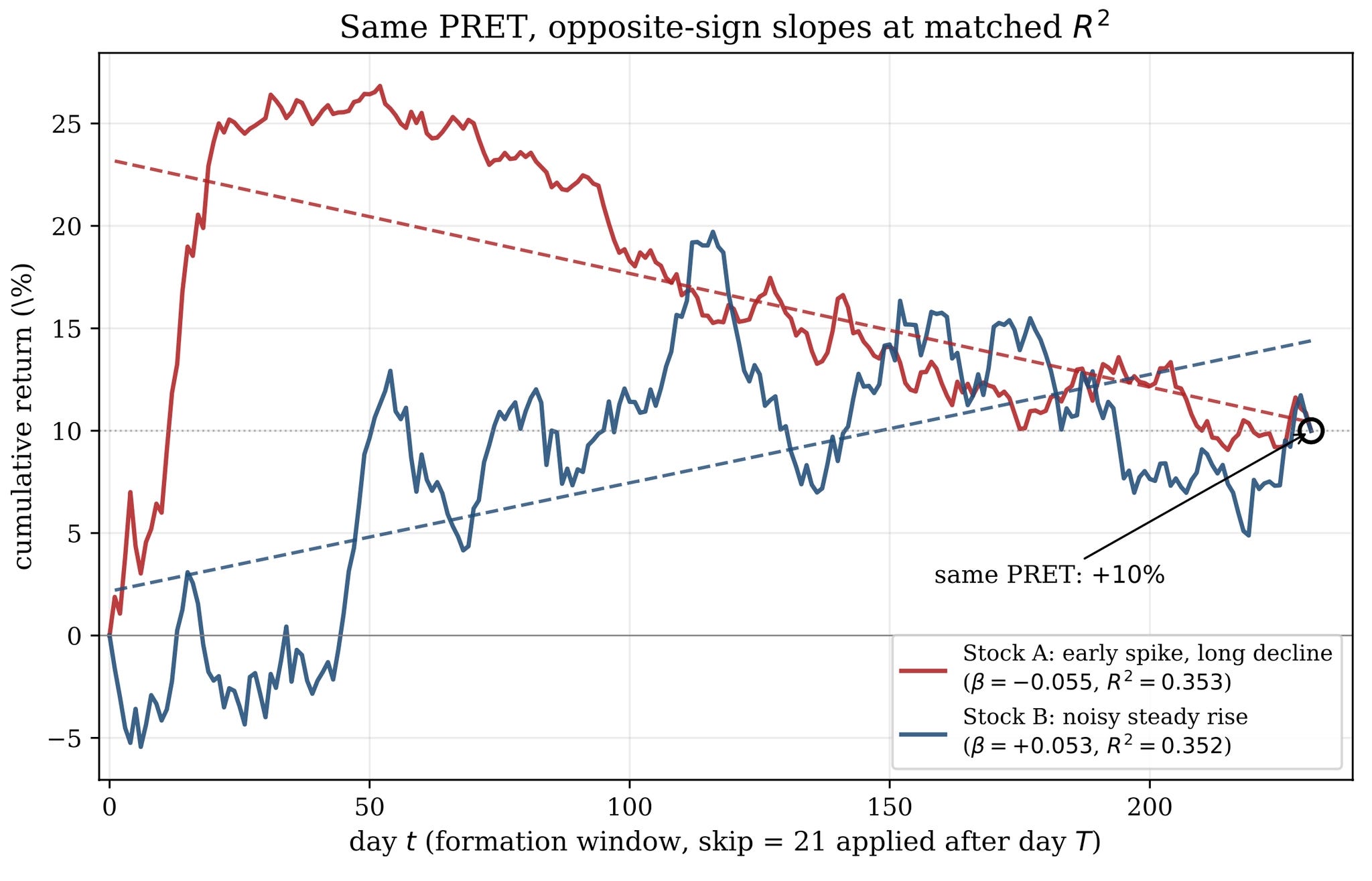
Imagine how many people have implemented the standard momentum factor and never thought of using the slope of the price path and the trend strength to improve its definition. Go long smooth uptrends, short noisy downtrends, and you get:
7.9% annual alpha (t = 3.44), net of Fama-French 5 + momentum,
A standalone Sharpe of 1.12 on the smoothness signal alone
If those are truly achievable numbers, that’s a discovery by Szent-Györgyi’s standards.
Here’s our plan:
First, we will quickly summarize the paper
Next, we will visualize the edge from the raw signal
Then, we will develop a few trading strategies based on this signal
Finally, we will wrap up with final thoughts and next steps
Throughout the article, we will share the Python code used in the implementation. So, if you are interested in implementation details, this is a good opportunity to follow along.
Let's get started.